Choosing the right Fountain Maker can determine whether your project feels refined or quickly becomes expensive to repair. A fountain is not only a decorative feature. It combines hydraulics, stonework, lighting, electrical systems, noise control, and long-term maintenance. The best choice depends on your site, water depth, climate, budget, and intended atmosphere. A quiet courtyard needs different equipment from a busy hotel entrance. That difference matters.
Mark Fuller, founder of WET, is widely recognized for large-scale water features. He has described fountains as “kinetic sculptures,” highlighting their movement, light, sound, and emotional impact. This idea is useful when comparing suppliers. Look beyond attractive photographs. Ask how the Fountain Maker calculates pump pressure, designs filtration, protects exposed components, and manages splash in windy conditions. Request drawings, material samples, maintenance schedules, and evidence from completed installations. A polished portfolio helps, but it does not prove technical reliability.
Experience also appears in small details. Does the maker allow access to pumps without removing heavy stone panels? Are replacement nozzles available locally? Can the control system adjust water height during dry weather? These questions reveal practical competence. Still, no supplier is perfect. Even a skilled Fountain Maker may underestimate cleaning time or seasonal operating costs. I have found that honest discussion of these weaknesses is more valuable than confident promises. Compare warranties carefully, confirm installation responsibilities, and evaluate communication before signing. The cheapest quotation may hide weaker filtration, louder pumps, or difficult servicing. A dependable partner should make the water beautiful, manageable, and safe for years.
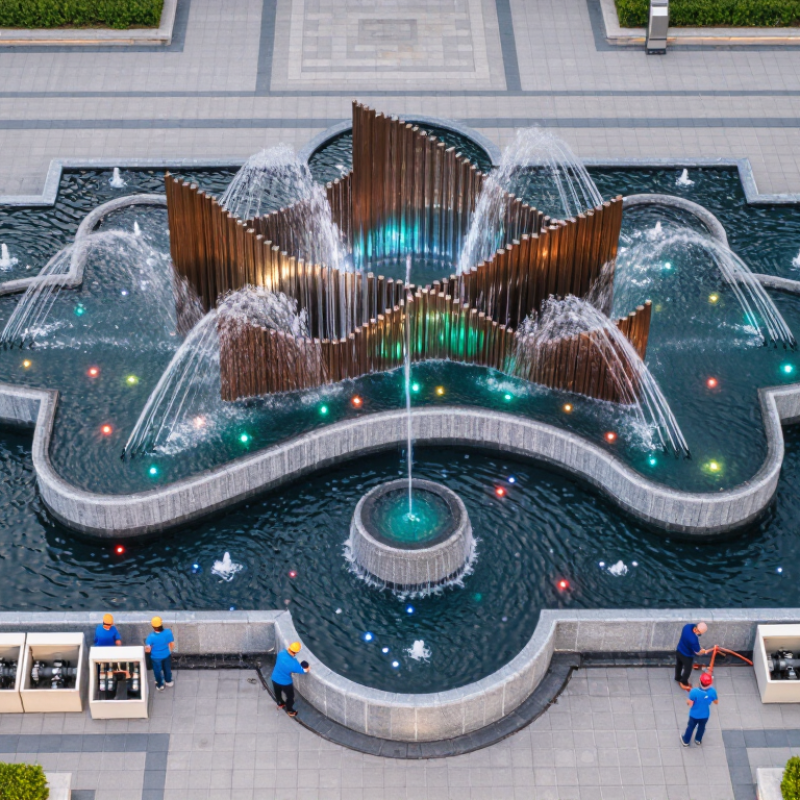
Choosing the best fountain maker begins with a clear purpose. A civic plaza may need a bold focal point, while a hotel courtyard may require quiet, elegant movement. Decide whether visitors will watch, hear, touch, or walk around the water. This choice affects the basin shape, nozzle height, lighting, and safety details.
Scale must match the space and viewing distance. A five-meter jet can disappear beside a large public building. It may feel overwhelming in a small garden. Measure the available footprint, pedestrian routes, and nearby sightlines before requesting designs. Check the proposed water volume, pump capacity, structural load, and maintenance access. I once judged a fountain by its visual appeal alone. That assumption failed when technicians struggled to reach the filtration equipment.
Site conditions often decide whether a concept succeeds. Record sunlight, prevailing wind, drainage points, soil stability, and available electrical capacity. Wind can scatter spray onto paving, causing slippery surfaces and excessive water loss. Hard water may leave mineral marks on dark stone. Nearby trees can add leaves and organic debris. Ask the fountain maker for site-specific calculations, material samples, cleaning procedures, and service records. Request drawings that show underground pipes and equipment clearances. Small details matter. A beautiful design can become costly when access panels are too narrow. Independent review by a qualified engineer can also expose weak assumptions before construction begins.
| Project Factor | Typical Data or Range | Why It Matters | What to Look for in a Fountain Maker | Recommended Project Direction |
|---|---|---|---|---|
| Primary purpose | Landscape feature, public attraction, commercial display, hospitality amenity, memorial, or interactive play feature | The purpose determines the required visual impact, control system, safety measures, operating schedule, and maintenance level. | Experience with projects serving a similar audience and operating environment; ability to provide concept design, engineering, installation, and after-sales support. | Select a maker whose previous technical capabilities match the intended use rather than choosing only by appearance. |
| Fountain format | Dry deck, reflecting pool, architectural jet, cascade, wall fountain, musical fountain, or interactive water feature | Each format has different requirements for drainage, waterproofing, pumps, controls, filtration, and user protection. | A maker that can explain the complete hydraulic and electrical system for the selected format, including emergency shutoff and access for service. | Use dry-deck systems where public access is important; use reflecting pools where visual calm and water reflection are the main objectives. |
| Overall fountain size | Small: under 3 m; medium: 3–10 m; large: over 10 m in overall length or diameter | Larger systems generally require more hydraulic capacity, structural coordination, control points, maintenance access, and installation planning. | Documented hydraulic calculations, scalable equipment selection, detailed drawings, and the ability to coordinate with civil, structural, and electrical contractors. | Choose a supplier with proven experience at the same project scale and with comparable water effects. |
| Water-jet height | Decorative jets: approximately 0.3–1.5 m; landmark jets: approximately 2–10 m or more | Jet height affects pump sizing, wind sensitivity, splash control, viewing distance, and nearby building or pedestrian conditions. | Ability to calculate nozzle performance under actual site conditions and provide adjustable flow control for different operating modes. | Use lower jets in confined pedestrian areas and consider taller effects only when wind, drainage, and safety zones are adequately managed. |
| Available site area | Record the usable length, width, clear height, setbacks, access routes, and equipment-room location in metres | The available footprint controls the basin layout, viewing angles, safety clearance, maintenance routes, and equipment placement. | A maker that can produce a site-specific layout instead of offering only a standard module or catalogue design. | Request a scaled plan showing nozzles, drains, access panels, electrical cabinets, pump rooms, and maintenance clearances. |
| Water source and replenishment | Recirculating system with make-up water for evaporation, splash-out, cleaning, and controlled drainage | Recirculation reduces continuous water consumption, while make-up and overflow systems maintain water quality and operating level. | A complete water-balance calculation, automatic level control, overflow protection, drain-down strategy, and water-treatment recommendation. | Prioritize recirculation, efficient filtration, and easy cleaning access where operating costs or water availability are concerns. |
| Climate and wind exposure | Assess prevailing wind, seasonal temperature, rainfall, solar exposure, freezing risk, and airborne dust | Wind can distort jets and increase splash-out; freezing conditions can damage pipes, pumps, valves, and nozzles if water is not drained or protected. | Wind-sensitive design options, seasonal operating procedures, freeze-protection measures, and materials suitable for outdoor exposure. | Use wind sensors, adjustable programs, lower profiles, and automatic shutdown where weather conditions can change quickly. |
| Water quality | Consider hardness, pH, suspended solids, biological growth, and local treatment requirements | Poor water quality can cause scale, blocked nozzles, staining, odour, corrosion, and increased maintenance. | Filtration and treatment recommendations based on tested or documented water conditions, with accessible components for routine servicing. | Specify water treatment before final equipment selection, especially for fine nozzles, mist effects, or high-visibility installations. |
| Power supply | Confirm local voltage, frequency, available load, three-phase requirements, grounding, and electrical-room location | Pump motors, lighting, controllers, treatment equipment, and safety devices must be compatible with the available electrical infrastructure. | A complete load schedule, single-line diagram, protection strategy, control-panel specification, and compliance with local electrical codes. | Select variable-speed drives or staged pumping when adjustable performance and energy management are important. |
| Safety and public access | Pedestrian traffic, slip risk, water depth, electrical zones, emergency access, and interaction with children or vulnerable users | Public installations require careful control of slippery surfaces, entrapment hazards, water quality, electrical protection, and unexpected equipment access. | Risk assessment, anti-slip surface guidance, protected electrical equipment, emergency stop controls, safe access covers, and documented maintenance procedures. | For interactive installations, require a design review focused on user safety, hygiene, supervision, and local regulatory requirements. |
| Noise requirements | Quiet surroundings, mixed-use areas, residential edges, hospitality spaces, or high-traffic public zones | Pump vibration, falling water, equipment-room noise, and pipe turbulence can affect visitor comfort and nearby occupants. | Noise-control options such as vibration isolation, acoustic treatment, properly sized piping, and remotely located equipment. | Ask for expected operating noise, equipment-room details, and a mitigation plan before construction begins. |
| Control and programming | Manual operation, timed programs, sensor-based control, synchronized lighting, music, or remote monitoring | Control complexity affects project cost, operator training, troubleshooting, energy use, and the ability to change performances. | User-friendly controls, clear operating modes, backup procedures, password management, and training for site personnel. | Choose the simplest control architecture that satisfies the required experience and operating schedule. |
| Materials and durability | Stainless steel, reinforced concrete, stone, tile, glass, coated metals, plastics, and weather-resistant electrical enclosures | Material selection affects corrosion resistance, structural life, appearance, cleaning requirements, and compatibility with treated water. | Material specifications, corrosion considerations, replaceable wear parts, realistic warranty terms, and documented fabrication quality controls. | Match materials to water chemistry, outdoor exposure, cleaning chemicals, and expected visitor contact. |
| Maintenance access | Daily visual checks; periodic cleaning, filter servicing, nozzle inspection, pump maintenance, and winterization where applicable | Poor access increases downtime, labour cost, and the risk of small issues becoming major failures. | Accessible pump rooms, removable grilles, labelled valves, spare-parts lists, maintenance manuals, and technical training. | Evaluate lifetime serviceability and parts availability, not only the initial purchase price. |
| Budget and lifecycle cost | Include design, civil works, equipment, installation, controls, water treatment, electricity, cleaning, repairs, and replacement parts | A low initial quotation may omit site works, utilities, commissioning, seasonal protection, or long-term maintenance costs. | Transparent scope of supply, itemised quotation, exclusions, energy assumptions, commissioning plan, warranty, and service response terms. | Compare total cost of ownership over the expected service life instead of comparing equipment prices alone. |
| Selection decision | Purpose fit, technical compliance, site compatibility, safety, maintainability, delivery capability, and lifecycle value | The best fountain maker is the one that can deliver a safe, maintainable, site-specific system within the project’s operational and financial limits. | Require drawings, calculations, references for comparable work, clear responsibilities, realistic schedule, commissioning support, and long-term technical assistance. | Create a weighted evaluation matrix and score each proposal against the same technical, commercial, and site-specific criteria. |